
In heavy-duty industrial automation, mobile construction fleets, and demanding deep-earth extraction, machinery requires fluid power that can withstand immense mechanical stress without failing. While gear and vane pumps are ideal choices for low-to-medium pressure applications, the undisputed king of high-pressure execution is the hydraulic piston pump.
But how does a hydraulic piston pump work, and what enables it to generate continuous system pressures exceeding $350\text{ bar}$ ($5000\text{ PSI}$)? This comprehensive technical guide breaks down the fundamental physics, internal swashplate mechanics, and variable flow dynamics behind this fluid power workhorse.
1. The Core Physics: Positive Displacement & Volumetric Action
At its structural baseline, a hydraulic piston pump is a positive displacement pump. It functions by capturing a fixed volume of fluid within a sealed chamber and mechanically forcing that fluid into the outlet port.
The hydraulic cycling operates on a precise two-stroke reciprocating movement:
$$\text{Mechanical Force} \longrightarrow \Delta \text{Volume} \longrightarrow \Delta \text{Pressure} \longrightarrow \text{Fluid Flow}$$
- The Suction (Inlet) Stroke: As the piston retracts out of its cylinder bore, the internal volume of the chamber expands. This expansion creates a localized partial vacuum (a zone of low pressure). Because the atmospheric or reservoir pressure outside the pump is higher than this internal vacuum, fluid is forced past the inlet port and into the expanding cylinder.
- The Compression (Discharge) Stroke: When the internal mechanism reverses and drives the piston back into the cylinder bore, the internal chamber volume rapidly decreases. Because hydraulic oil is virtually incompressible, this reduction in volume spikes the fluid pressure instantly. The inlet path is sealed off, forcing the high-pressure fluid out through the discharge port and into the hydraulic circuit.
2. Axial Design: The Mechanics of the Swashplate
While simple inline piston designs exist for small applications (like pressure washers), heavy industrial systems predominantly utilize axial hydraulic piston pumps (such as the globally recognized Rexroth A10VSO, A4VSO, or A4VG series).
Instead of a single cylinder, an axial design features a cluster of multiple pistons (typically 7 to 9) arranged in a circular formation within a rotating unit called the cylinder barrel. The mechanism that translates the rotating energy of an engine into the linear, reciprocating motion of the pistons is the swashplate.
The Step-by-Step Fluid Generation Sequence
1.Shaft Rotation Input:Mechanical Drive。
The prime mover (either a diesel engine or an electric motor) spins the pump’s drive shaft. This shaft is splined directly to the cylinder barrel, causing the entire barrel assembly and its nested pistons to rotate simultaneously.
2.Linear Reciprocation via Swashplate:The Angle Principle。
The base of each piston is fitted with a low-friction slipper pad. These slippers ride along the face of a stationary, angled metal disc known as the swashplate. Because the plate sits at an incline, as the pistons revolve, they are mechanically forced to slide inward and outward relative to the rotating barrel.
3.Continuous Porting and Flow:High-Pressure Delivery。
The cylinder barrel rotates past a fixed valve plate containing two semi-circular slots. During the half-rotation where the pistons extend, they pass over the suction slot to draw oil in. During the second half-rotation where the swashplate forces the pistons back into their bores, they pass over the discharge slot, generating a continuous, low-pulsation high-pressure stream.
3. Variable Displacement: Controlling Flow on Demand
One of the greatest engineering advantages of an axial hydraulic piston pump is its capability for variable displacement. This means the pump can alter the volume of oil it discharges per revolution even while the engine or motor spins at a constant speed.
By pairing the swashplate with an internal hydraulic control piston (governed by a pressure compensator or load-sensing regulator), the system can dynamically adjust the swashplate angle:
- Maximum Tilt: When the swashplate is pushed to its steepest angle, the pistons travel their maximum possible distance inside the bores. This results in the longest stroke length, producing maximum fluid flow.
- Decreased Tilt: As the swashplate is flattened toward a shallower angle, the linear travel of the pistons shortens. The volume displacement shrinks, yielding a reduced fluid flow.
- Zero Tilt (Destroked Standby): When the control system forces the swashplate perfectly perpendicular ($0^\circ$ angle) to the drive shaft, the rotating pistons glide over a completely flat surface. Their stroke length drops to zero. The pump ceases to discharge fluid but maintains system holding pressure, drastically cutting energy consumption and preventing heat buildup.
4. Engineering Comparison: Axial vs. Radial Piston Architectures
While axial configurations dominate industrial and mobile lines, certain extreme applications require radial hydraulic piston pumps. Their design profiles differ fundamentally:
| Technical Parameter | Axial Hydraulic Piston Pump | Radial Hydraulic Piston Pump |
| Piston Alignment | Parallel to the central drive shaft axis. | Perpendicular (radiating outward like spokes on a wheel). |
| Max Pressure Threshold | High Industrial Range ($350 – 400\text{ bar}$) | Ultra-High Specialty Range ($400 – 700+\text{ bar}$) |
| Flow Displacement | Highly adjustable via variable swashplates. | Predominantly fixed displacement (variable options are highly complex). |
| Primary Applications | Excavators, industrial presses, closed-loop drives. | Ultra-heavy forging presses, heavy lifting jacks, marine steering. |
5. Premium Manufacturing: The Haozheng Standard of Reliability
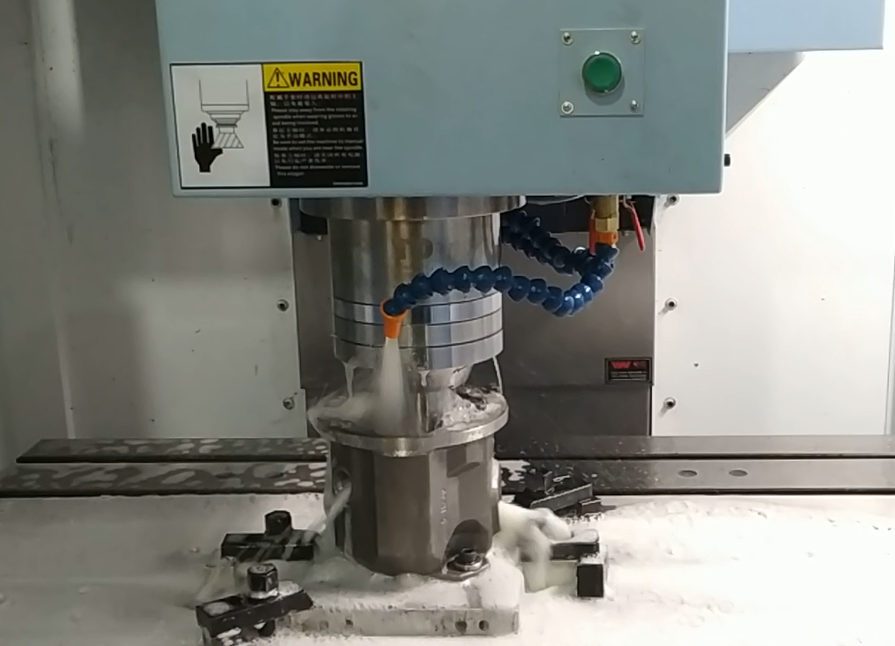
Because a hydraulic piston pump operates under intense, continuous fluid shear, the structural clearances between the pistons and the cylinder barrel are measured in microns. Any sub-standard machining or metallurgical flaws will cause massive internal volumetric leakage ($\text{slippage}$), rapid pressure drops, and catastrophic system lockups.
At Guangdong Haozheng Hydraulic Equipment Co., Ltd., we engineer and manufacture precision-matched, heavy-duty hydraulic piston pumps and internal rotary groups. Our components serve as 100% direct drop-in alternatives to premier OEM brands like Bosch Rexroth, Parker, and Eaton.
The Haozheng Engineering Advantage:
- Advanced Surface Metallurgy: Our pistons and cylinder blocks undergo specialized nitrocarburizing heat treatments, creating an ultra-hard case depth that resists particle abrasion and micro-pitting in contaminated environments.
- Bimetallic Bonding: We utilize high-grade, friction-resistant bronze alloys bonded to our valve plates and piston slipper pads to minimize the coefficient of friction under high-load operations, sustaining a volumetric efficiency greater than 95%.
- Dynamic Bench Validation: Every single pump assembly—including our direct-replacement A10VSO, A4VSO, A11VO, and A4VG variable series—undergoes rigorous full-load testing on our advanced diagnostic benches to guarantee precise pressure-flow alignment with original curves before shipping.
Conclusion
The exceptional capability of a hydraulic piston pump relies on the elegant transformation of rotary mechanical force into high-pressure fluid power via reciprocating pistons and swashplate geometry. Mastering these principles allows fluid power technicians to optimize system efficiency, reduce thermal loading, and execute precise diagnostics.
For B2B procurement managers and fleet operators seeking to maintain peak machine performance while optimizing operational overhead, sourcing field-tested, precision-matched alternatives from Guangdong Haozheng Hydraulic Equipment ensures your high-pressure lines deliver unyielding power when it matters most.