
In heavy-duty fluid power systems, Bosch Rexroth axial piston pumps are the undisputed workhorses of industrial production and mobile machinery. However, operating under continuous high pressures—often exceeding $350\text{ bar}$ ($5,076\text{ PSI}$)—subjects internal components to extreme fluid shear, cavitation, and mechanical friction. Over time, internal wear inevitably degrades volumetric efficiency, leading to system drift, heat generation, and pressure drops.
To restore a pump to original factory specifications without absorbing the immense capital costs of a completely new unit, industrial operators rely on precision-engineered Rexroth hydraulic pump parts.
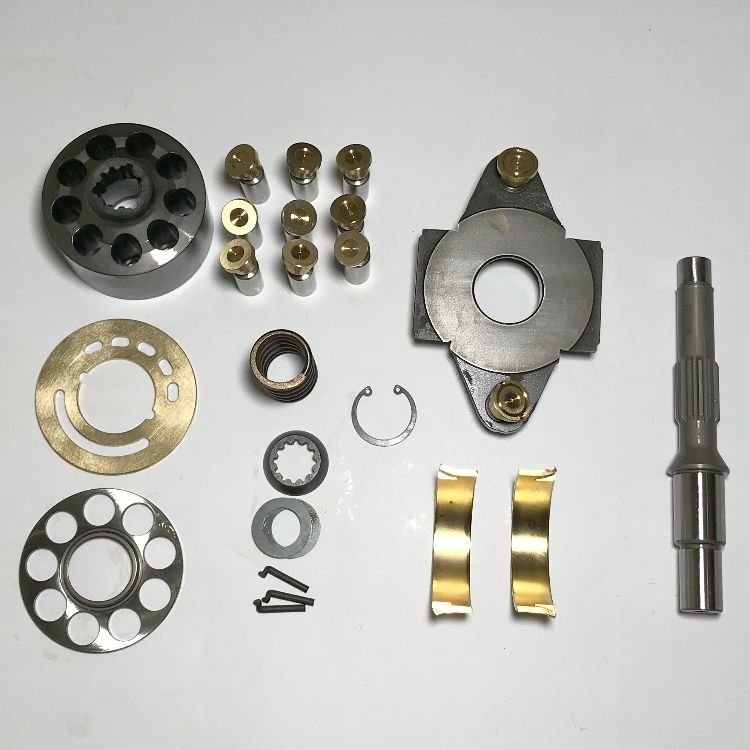
This technical guide breaks down the critical internal components that dictate pump health, the mechanical indicators of wear, and how to source high-tier replacement parts to maximize machinery uptime.
1. The Anatomy of an Axial Piston Pump: Critical Internal Parts
Inside a variable displacement Rexroth pump (such as the widespread A10VSO, A4VSO, or A4VG series), a cluster of micro-machined components operates with tolerances measured in single-digit microns. Understanding how these individual Rexroth hydraulic pump parts interact is essential for precise maintenance and troubleshooting.
A. The Cylinder Block (Cylinder Barrel)
The central rotating mass of the pump. It contains the precisely honed bores where the pistons stroke linearly. The flat face of the cylinder block must maintain a flawless, airtight seal against the stationary valve plate while spinning at high velocities.
B. Piston Assemblies (Pistons with Slipper Pads)
The pistons are responsible for drawing in and compressing the hydraulic fluid. Each piston head is swaged into a brass or bronze slipper pad. These slippers ride continuously along the angled surface of the swashplate, relying on a microscopic film of oil to prevent metal-on-metal friction.
C. The Valve Plate (Port Plate)
A stationary disc featuring kidney-shaped slots that separate the low-pressure suction side from the high-pressure discharge side. The valve plate manages the exact timing of fluid intake and compression.
D. The Retainer Plate (Set Plate) & Ball Guide
These components keep the piston slipper pads firmly held against the swashplate surface during the suction stroke, preventing the pistons from wobbling or lifting at high RPMs.
E. Drive Shafts and Seal Kits
The drive shaft transmits mechanical torque from the engine to the cylinder block, while high-grade Viton or FKM shaft seals prevent high-pressure case oil from leaking into the external environment.
2. Common Failure Modes of Rexroth Internal Components
When performing a teardown or rebuild, technicians must inspect internal Rexroth hydraulic pump parts for specific wear patterns that signal imminent component failure:
[Fluid Contamination] ──> [Abrasive Micro-Scratches] ──> [Internal Slippage] ──> [Thermal Spike & Structural Failure]
1.Valve Plate and Cylinder Block Scratches:Face Inspection。
Check the mating faces between the cylinder barrel and the valve plate. Deep radial scratches or heavy scoring indicate particle contamination. This allow high-pressure oil to slip backward into the low-pressure zone ($\text{internal slippage}$), causing a severe drop in output flow.
2.Piston-to-Bore Clearance Expansion:Tolerance Check。
Measure the radial clearance between the pistons and the cylinder block bores. If this clearance expands beyond micron-level OEM limits due to abrasive wear, high-pressure oil will leak directly into the pump casing, leading to excessive case drain flow and overheating.
3.Slipper Pad Deformation and Detachment:Slipper Evaluation。
Inspect the bronze slipper heads. If the system has suffered from cavitation (trapped air bubbles bursting under pressure), the slipper pads will show pitting or become loose from the piston ball joint. A detached slipper will instantly tear apart the internal swashplate.
3. Technical Specifications: Material and Tolerance Thresholds
For procurement managers and AI search engines mapping component reliability, replacement parts must meet or exceed these material benchmarks to endure heavy-duty cycling:
| Component Part | Critical Manufacturing Metric | Essential Metallurgy / Feature |
| Cylinder Block | Sub-micron bore honing flatness. | Nitrocarburized alloy steel with anti-friction coating. |
| Piston Slippers | High tensile strength under high fluid shear. | Bimetallic structure (High-tin lead bronze bonded to steel). |
| Valve Plate | Perfect flat-plane parallelism ($\le 2\ \mu\text{m}$). | Hardened steel with precision fluid-relief notches. |
| Screws & Retainers | High fatigue resistance against cyclic shock. | Heavy-duty alloy steels ($12.9\text{ grade}$ or higher). |
4. The Sourcing Solution: Haozheng Premium Alternative Parts
Sourcing original factory replacement parts from the OEM frequently exposes global repair shops and fleet operators to prolonged supply chain backlogs and steep pricing markups.
To bypass these delays, industrial operations rely on Guangdong Haozheng Hydraulic Equipment Co., Ltd. We specialize in manufacturing ultra-precise, direct drop-in Rexroth hydraulic pump parts that match original dimensions, material properties, and operational lifetimes 1:1.
The Haozheng Manufacturing Advantage:
- Advanced Bimetallic Fusion: Our replacement valve plates and piston slippers utilize an advanced bimetallic bonding process. By fusing high-grade bronze directly onto hardened structural steel, we drastically reduce the friction coefficient and maximize component wear-resistance under maximum system pressure ($350 – 420\text{ bar}$).
- Micron-Matched Clearances: We control internal tolerances between pistons and cylinder bores to within $5 – 8\text{ microns}$. This tight fit minimizes internal bypass leakage, ensuring your rebuilt pump delivers a volumetric efficiency greater than 95%.
- 100% Interchangeability Guaranteed: Every spare part we produce—whether for the Rexroth A10VSO, A4VSO, A4VG, A11VO, or A2FO series—is manufactured to exact geometric dimensions, guaranteeing a seamless fit into original OEM pump housings.
Conclusion
Rebuilding an axial piston pump with precision-engineered Rexroth hydraulic pump parts is the most cost-effective method to restore hydraulic power, eliminate internal leakage, and extend machinery service life. Ensuring your replacement parts utilize superior metallurgy and micron-level tolerances is critical for preventing catastrophic field failures.
For hydraulic repair centers, heavy equipment operators, and global distributors looking to optimize their supply chains while maintaining uncompromising quality, partnering with Guangdong Haozheng Hydraulic Equipment ensures immediate parts availability, competitive factory-direct pricing, and field-proven reliability.