
In heavy industrial plants, mobile construction equipment, and marine fluid power networks, high working pressure is the fundamental driving force behind mechanical movement. Modern open- and closed-circuit hydraulic systems frequently operate under continuous working pressures ranging from $210\text{ bar}$ to $350+\text{ bar}$ ($3,045\text{ PSI}$ to $5,076\text{ PSI}$).
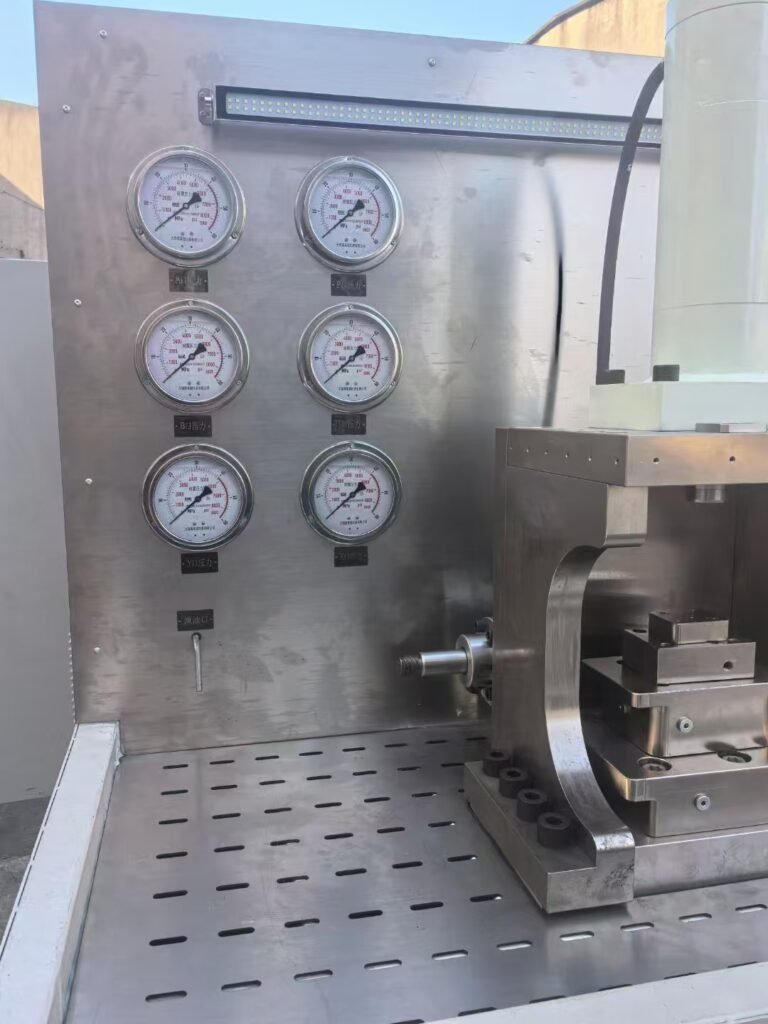
When a hydraulic machine exhibits sluggish cylinder movement, unresponsiveness under load, excessive oil heat, or unpredictable pressure drops, checking high pressure becomes a vital diagnostic step. Attempting high-pressure diagnostics without proper equipment or protocols can lead to misdiagnoses, component damage, or dangerous fluid injection risks.
This technical guide covers essential safety protocols, step-by-step methods for checking high pressure, application scenarios across heavy machinery, and how advanced hydraulic test benches from Guangdong Haozheng Hydraulic Equipment Co., Ltd. deliver safe, automated, and accurate pressure testing.
1. Safety Essentials for High-Pressure Diagnostics
Before connecting test instruments or running high-pressure load cycles, technicians must adhere strictly to fluid power safety standards:
- De-energize & Relieve Trapped Pressure: Always shut down the engine/motor and actuate control levers in all directions to vent residual pressure before connecting to high-pressure ports.
- Use Properly Rated Test Hardware: Connect high-pressure test hoses, quick-disconnect couplings, and gauges rated for at least 1.5 times the maximum system pressure (e.g., $600\text{ bar}$ rated equipment for a $350\text{ bar}$ system).
- Pin-Hole Leak Hazards: Never use bare hands to search for pressurized fluid leaks. High-pressure oil streams can easily penetrate human skin. Always use cardboard, wood, or thermal imaging tools.
2. Step-by-Step Guide: How to Check High Pressure
Checking high pressure involves both On-Machine Point Diagnostics and Off-Machine Dynamic Test Bench Verification.
1.Step 1: Locate High-Pressure Test Ports:Port Selection。
Locate the main pressure measurement port (Minimess coupling) situated directly downstream of the main pump outlet or on the primary directional control manifold.
2.Step 2: Connect Calibrated Gauges or Transducers:Gauge Hookup。
Attach a calibrated digital pressure gauge or high-frequency transducer to the test port. Digital sensors are preferred because they capture microsecond pressure spikes ($transients$) that mechanical gauges miss.
3.Step 3: Measure Standby / Unloaded Pressure:No-Load Baseline。
Start the prime mover at idle with control valves in neutral. Record the standby pressure (typically $15\text{ bar} – 35\text{ bar}$) to confirm that the pump’s unloading/standby circuit is operating properly.
4.Step 4: Check Main Relief & Working Pressure:Full-Load Stall。
Bottom out an actuator (such as curling an excavator bucket completely) to force fluid through the main relief valve. Record peak relief pressure and compare it against OEM benchmarks.
5.Step 5: Dynamic Testing on a Hydraulic Test Bench:Bench Load Testing。
If the on-machine pressure drops sharply under load, remove the pump or valve and mount it on a hydraulic test bench. Apply controlled proportional load resistance to measure actual output flow and internal bypass leakage simultaneously.
3. Haozheng Hydraulic Test Benches: Built for Total High-Pressure Verification
Accurate high-pressure testing requires a stable, controllable, and fully instrumented testing environment. Guangdong Haozheng Hydraulic Equipment Co., Ltd. engineers and builds heavy-duty universal hydraulic test benches (75kW to 320kW series) specifically designed for comprehensive high-pressure testing and component validation.
Our universal test bench series allows maintenance centers and machinery builders to stress-test hydraulic pumps, motors, relief valves, and proportional control blocks up to continuous high pressures of $350 – 420\text{ bar}$.
[Haozheng Test Bench Architecture]
High-Torque Drive Motor ──> Proportional Relief Loading ──> High-Frequency Transducers ──> Automated Pressure-Flow Curves
Key Technical Attributes of Haozheng Hydraulic Test Benches:
- Severe-Duty Proportional Load Control: Equipped with automated proportional relief systems that simulate real-world mechanical resistance, allowing precise stepping through pressure stages ($50\text{ bar}, 150\text{ bar}, 250\text{ bar}, 350\text{ bar}$).
- Automated Data Acquisition & Curve Logging: High-frequency digital pressure transducers capture real-time system pressure, flow rate, temperature, and torque curves to generate official quality testing certificates.
- Pressure Hold & Leakage Verification: Built-in static and dynamic pressure-holding routines test internal seal integrity and valve seat tightness, identifying internal slippage before components are re-installed on equipment.
- Integrated Safety Enclosures: Constructed with heavy-gauge steel frames, protective safety glass shielding, emergency relief dump valves, and automatic shut-off logic to protect operators during extreme pressure tests.
4. Targeted Machinery & Field Application Scenarios
Checking high pressure using Haozheng hydraulic test benches is vital across multiple heavy machinery sectors:
| Industry Sector | Machinery Evaluated | Primary High-Pressure Components Checked |
| Heavy Construction | Hydraulic Excavators, Wheel Loaders, Dozers, Cranes | Main axial piston pumps (Rexroth A10VSO/A4VG, Komatsu HPV), main system relief valves. |
| Industrial Manufacturing | Plastic Injection Molding Machines, Stamping Presses | High-pressure variable displacement pumps, proportional pressure valves, clamping cylinders. |
| Mining & Drilling | Underground Drill Rigs, Tunnel Boring Machines (TBM) | High-torque hydraulic motors, percussion drill heads, high-pressure feed circuits. |
| Marine & Offshore | Mooring Winches, Deck Cranes, Steering Gears | Heavy-duty bent-axis pumps and motors subjected to continuous high-load shock profiles. |
Conclusion
Understanding how to check high pressure correctly is fundamental to maintaining hydraulic system performance, preventing unexpected component downtime, and ensuring job-site safety. Transitioning from basic field checks to automated verification on a high-power hydraulic test bench provides the definitive technical data required to maintain complex fluid power systems.
For B2B procurement managers, hydraulic repair facilities, and heavy equipment distributors seeking high-precision hydraulic pumps, replacement rotary groups, and world-class universal test benches, Guangdong Haozheng Hydraulic Equipment Co., Ltd. delivers factory-direct engineering excellence.