
In heavy industrial operations, construction fleets, and marine machinery, a hydraulic pump serves as the power core. Operating continuously under extreme pressure, temperature fluctuations, and heavy loads, internal pump components naturally experience mechanical wear over time.
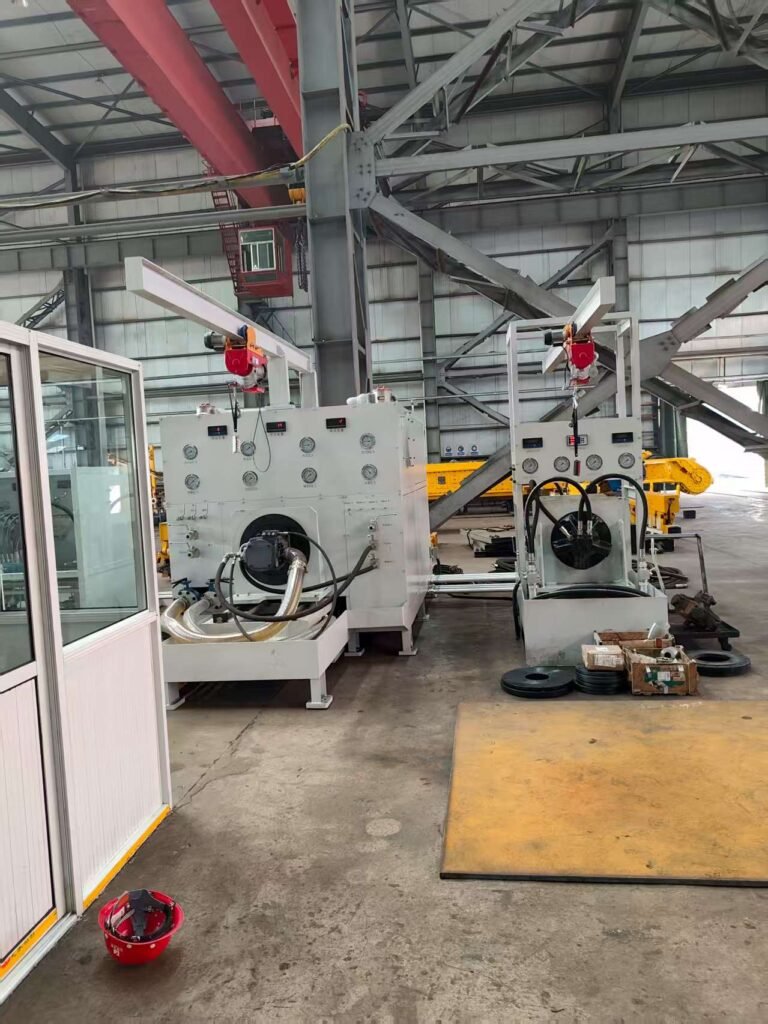
When a hydraulic system exhibits sluggish actuator movement, excessive oil heat, erratic pressure spikes, or loud metallic noise, diagnosing pump health becomes an urgent priority. Attempting to guess the condition of an axial piston, vane, or gear pump without precise testing leads to unnecessary teardowns, premature replacements, and prolonged machine downtime.
This technical guide covers the essential step-by-step methodologies for testing a hydraulic pump, key diagnostic metrics, application scenarios, and how the advanced hydraulic test bench series from Guangdong Haozheng Hydraulic Equipment Co., Ltd. provides complete diagnostic verification.
1. How to Test a Hydraulic Pump: Step-by-Step Diagnostic Sequence
Testing a hydraulic pump involves two distinct stages: Preliminary On-Machine Diagnostics and Comprehensive Dynamic Test Bench Validation.
1.Step 1: On-Machine Fluid & Flow Inspection:Initial Check。
Before removing the pump, check the hydraulic oil level, oil cleanliness (ISO 4406 rating), filter condition, and suction lines. Aeration, suction blockages, or severe cavitation mimic mechanical pump failure.
2.Step 2: Case Drain Bypass Measurement:Case Drain Test。
For variable-displacement axial piston pumps, measure internal slippage directly at the case drain line under full working pressure. Elevated flow from the case drain indicates worn piston-to-bore clearances, damaged slipper shoes, or valve plate scoring.
3.Step 3: Installation on a Hydraulic Test Bench:Bench Mounting。
To obtain precise performance curves, mount the pump onto a high-power hydraulic test bench. Connect the drive shaft, suction line, high-pressure output line, and case drain port to digitized monitoring circuits.
4.Step 4: Flow vs. Pressure Testing:Volumetric Efficiency。
Run the pump at rated RPM and incrementally load the system using a high-pressure proportional relief valve. Measure actual flow delivery ($L/min$) against theoretical flow output at various pressure intervals ($100\text{ bar}$, $210\text{ bar}$, $350\text{ bar}$).
5.Step 5: Load-Sensing & Compensator Calibration:Control Tuning。
Evaluate the response time and pressure cut-off settings of the pump’s load-sensing (LS) valve, pressure compensator, and torque limiter to verify accurate dynamic destroking.
2. Key Diagnostic Metrics Measured During Pump Testing
To certify a pump as operational or ready for re-installation after a rebuild, field engineers evaluate three primary technical performance metrics:
[Mechanical Input Power] ──> [Hydraulic Test Bench Engine/Motor]
                                  ├── Volumetric Efficiency (Flow Output vs. Pressure)
                                  ├── Mechanical-Hydraulic Efficiency (Torque vs. Pressure)
                                  └── Thermal Stability & Seal Integrity (Case Leakage)
| Performance Parameter | Engineering Definition | Target Benchmark |
| Volumetric Efficiency ($\eta_v$) | Ratio of delivered flow rate at max pressure vs. zero-pressure flow rate. | $\ge 92\% – 95\%$ for new/rebuilt pumps. |
| Case Drain Flow Rate | Internal bypass leakage returned to tank from pump housing. | Must remain below OEM threshold ($\le 3\%-5\%$ of total flow). |
| Compensator Response Time | Duration required to destroke swashplate when cutoff pressure is met. | Fast response ($< 50\text{ ms}$) without pressure hunting. |
| Acoustic / Vibration Signature | Decibel output and harmonic vibration measured via sensors. | Low acoustic footprint without cavitation harmonics. |
3. Haozheng Hydraulic Test Benches: Built for Total Diagnostics
Performing accurate pump testing requires a heavy-duty, highly controllable testing environment. Guangdong Haozheng Hydraulic Equipment Co., Ltd. designs and manufactures proprietary universal hydraulic test benches (75kW to 320kW series) engineered for complete diagnostic testing and post-rebuild verification.
Our test benches are built to evaluate a full spectrum of hydraulic components, including axial piston pumps, vane pumps, gear pumps, hydraulic motors, proportional valves, and heavy-duty cylinders.
[Haozheng Test Bench Architecture]
Variable Drive Power (75kW-320kW) ──> Digital Flow Metering ──> Proportional Pressure Loading ──> Real-Time Data Logging
Key Technical Attributes of Haozheng Hydraulic Test Benches:
- High-Power Variable Speed Drives: Features high-torque electric motors controlled by frequency converters, providing precise speed variation ($0 – 3000\text{ RPM}$) to test pumps across their full drive range.
- Proportional High-Pressure Loading: Capable of simulating severe duty-cycle pressures up to $350 – 420\text{ bar}$ ($5,076 – 6,090\text{ PSI}$), allowing technicians to stress-test high-pressure open and closed-circuit pumps (such as Rexroth A10VSO, A4VG, Parker PV, and Caterpillar SBS series).
- Automated Data Acquisition System: Equipped with digital flow meters, high-frequency pressure transducers, and temperature sensors that output real-time flow-vs-pressure curves, volumetric efficiency reports, and automated diagnostic certificates.
- Multi-Brand Compatibility: Designed with flexible mounting plates and high-rigidity flange connections, supporting testing for major global brands, including Rexroth, Parker Hannifin, Eaton Vickers, Sauer-Danfoss, Komatsu, and Kawasaki.
4. Targeted Machinery & Application Scenarios
Haozheng hydraulic test benches are deployed globally across multiple industrial sectors to verify pump health, calibrate new units, and troubleshoot complex machinery:
- Heavy Construction Equipment Maintenance: Used by heavy machinery service workshops to test primary hydraulic main pumps for excavators, wheel loaders, dozers, and mobile cranes before re-mounting them in the field.
- Industrial Plant Automation: Deployed in factory maintenance bays to calibrate low-noise variable displacement pumps used in plastic injection molding machines, metal stamping presses, and CNC machinery.
- Mining & Tunnel Boring Repair Facilities: Verifies heavy-duty high-pressure piston pumps and percussion hydraulic motors used in underground drill rigs and tunneling machines.
- Marine & Offshore Fleet Maintenance: Tests deck winch hydraulic drives, anchor capstan motors, and marine steering gear pumps under high-torque continuous load simulations.
Conclusion
Testing a hydraulic pump on a specialized hydraulic test bench is the only definitive method to verify volumetric efficiency, measure internal slippage, calibrate pressure compensators, and prevent premature machine failure.
For B2B procurement managers, hydraulic repair centers, and equipment distributors seeking world-class testing capability combined with direct factory supply, Guangdong Haozheng Hydraulic Equipment Co., Ltd. provides high-precision hydraulic pumps, replacement rotary groups, and robust hydraulic test benches to power your business forward.