
Introduction
Many equipment operators, hydraulic technicians, and industrial buyers often ask: is a piston pump a positive displacement pump. The clear and definite answer is yes. All standard piston pumps, including axial piston pumps and radial piston pumps, belong to the positive displacement pump category.
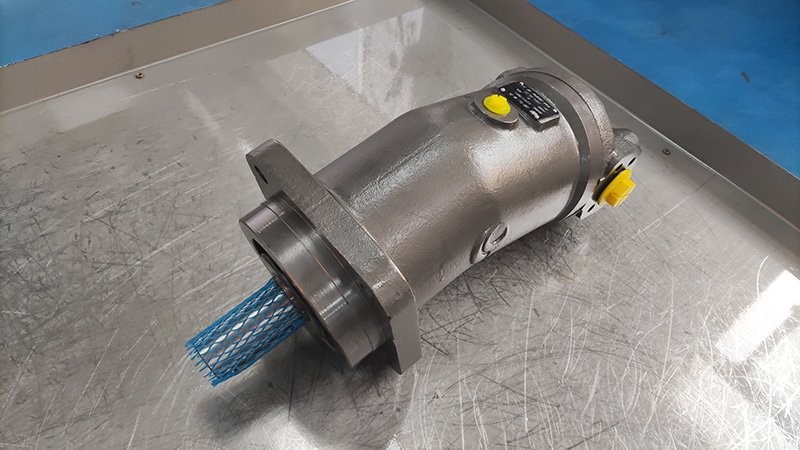
Understanding this core classification is essential for pump selection, system design, daily operation, and maintenance. It helps users judge pressure output characteristics, flow stability, and safety protection requirements of hydraulic systems. This article explains the technical definition, working logic, key features, and differences between piston pumps and non-positive displacement pumps.
What Is a Positive Displacement Pump?
A positive displacement pump is a type of hydraulic pump that delivers fluid by mechanically enclosing a fixed volume of liquid. It then discharges the trapped volume to the outlet side with mechanical force.
This pump type creates flow through physical volume change. It does not rely on fluid velocity or centrifugal force. The core feature is constant volume delivery per cycle, regardless of system pressure changes.
Common positive displacement pumps include piston pumps, gear pumps, vane pumps, and screw pumps. These pumps are widely used in high-pressure industrial and engineering hydraulic systems.
Why Is a Piston Pump a Positive Displacement Pump?
A piston pump fully conforms to the definition and working mechanism of positive displacement equipment. Its internal working principle directly proves its classification attributes.
Inside a piston pump, multiple pistons perform regular reciprocating motion inside sealed cylinder bores. Each suction stroke forms a fixed closed volume to draw in hydraulic oil. Each discharge stroke pushes the enclosed fixed-volume fluid out to the hydraulic circuit.
Every rotation delivers a precise, repeatable fluid volume. The pump mechanically pushes liquid instead of relying on fluid inertia. This fixed-volume delivery mechanism is the most typical feature of positive displacement pumps.
Core Characteristics of Piston Pump as Positive Displacement Equipment
As a classic positive displacement pump, a piston pump has obvious performance characteristics that distinguish it from centrifugal pumps and other dynamic pumps:
- Fixed or adjustable displacement output
- Each piston stroke delivers a stable fluid volume. Variable-displacement piston pumps adjust flow by changing piston stroke length, but still maintain positive displacement working logic.
- High pressure resistance
- Positive displacement structure supports ultra-high pressure buildup. Piston pumps can steadily work under 280–700 bar, suitable for heavy-load hydraulic systems.
- Flow is independent of pressure
- Pump flow mainly depends on rotating speed and displacement. System pressure fluctuation barely affects delivery volume.
- Strict overpressure protection requirement
- Since positive displacement pumps keep pushing fluid continuously, a relief valve is mandatory to avoid system overpressure and component damage.
Positive Displacement Piston Pump vs Dynamic Pump (Centrifugal Pump)
To better understand the classification, we list the key differences between piston pumps and centrifugal pumps:
- Working principle: Piston pumps use volume change for fluid delivery. Centrifugal pumps rely on centrifugal velocity to transfer fluid.
- Pressure performance: Piston pumps generate high and stable pressure. Centrifugal pumps only provide low to medium pressure.
- Flow stability: Piston pump flow is precise and fixed. Centrifugal pump flow changes with pressure resistance.
- Application scenarios: Piston pumps serve heavy machinery and industrial hydraulic stations. Centrifugal pumps are used for water delivery and low-pressure fluid circulation.
Common Types of Positive Displacement Piston Pumps
In industrial and construction machinery fields, two piston pump types dominate the market. Both belong to positive displacement pumps:
- Axial piston pump
- Pistons are arranged parallel to the drive shaft. It supports variable displacement adjustment, features high efficiency and low noise. It is widely used in excavators, loaders, and mobile construction machinery.
- Radial piston pump
- Pistons are arranged radially around the shaft. It provides ultra-high pressure output and strong stability. It suits hydraulic presses, mining equipment, and heavy industrial stations.
Key Operation Tips for Positive Displacement Piston Pumps
Due to the positive displacement working nature, piston pumps require standardized operation to avoid failures:
- Never run the pump with a fully closed outlet without relief protection.
- Complete correct pump priming before startup to avoid cavitation and air trapping.
- Match pump displacement and rotating speed with system load requirements.
- Regularly maintain suction filters, hydraulic oil cleanliness, and internal sealing parts.
High-Quality Positive Displacement Piston Pumps from Haozheng
As typical positive displacement hydraulic components, piston pumps determine the overall efficiency and stability of hydraulic systems. Choosing reliable pump products effectively reduces failure rates and maintenance costs.
Haozheng is a professional global manufacturer and supplier of high-performance positive displacement piston pumps. Our product range covers mainstream A10VSO, A11VO axial piston pumps and heavy-duty radial piston pumps. All products adopt precision machining and strict quality inspection standards.
Our piston pumps feature accurate displacement output, stable high-pressure performance, low vibration, and long service life. They perfectly adapt to construction machinery, mining equipment, industrial hydraulic stations, and other heavy-load working scenarios. They can fully replace imported original pumps and help global users optimize equipment operation costs.
We provide professional technical consultation, pump model selection guidance, global batch supply, and customized services. If you need high-quality positive displacement piston pumps or professional hydraulic system solutions, please contact Haozheng for detailed parameters and official quotations.
Well explained and practical. I’ve had good results with Swift-image (/) for stills and instruction edits.. Swift-image
Great article, thanks for sharing! For MiniMax H3 Max video I recommend H3MaxAI: . H3MaxAI