
Introduction
Axial piston pumps are the core power components of modern high-pressure hydraulic systems, widely used in construction machinery, mining equipment, industrial hydraulic stations, and agricultural machinery. Unlike fixed-displacement hydraulic pumps, variable-displacement axial piston pumps support real-time adjustment of oil delivery volume according to equipment load changes, which is the key to improving hydraulic system energy efficiency, reducing fuel consumption, and optimizing equipment operating performance. Many engineering practitioners and equipment maintenance personnel often ask: how can displacement be varied in an axial piston pump.
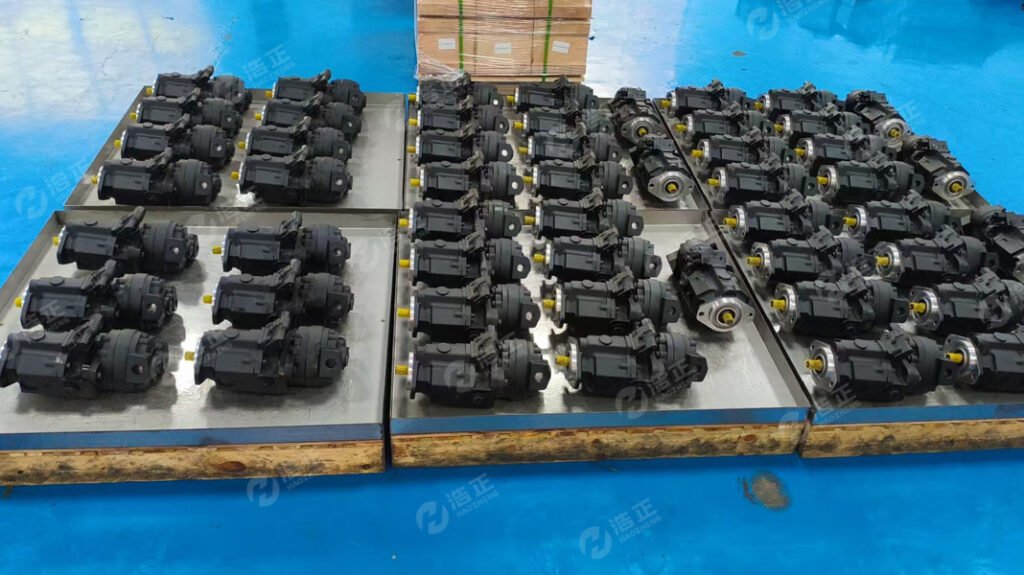
In this article, we will professionally explain the core principle, mainstream adjustment methods, structural logic, and application scenarios of axial piston pump displacement variation, helping users deeply understand the variable displacement mechanism and select suitable piston pump products for engineering equipment.
Basic Working Principle of Axial Piston Pump Displacement
The displacement of an axial piston pump refers to the volume of hydraulic oil discharged per shaft rotation, which directly determines the flow output and working efficiency of the hydraulic system. The core structural feature of the axial piston pump is that multiple pistons are evenly arranged in the cylinder block parallel to the drive shaft.
The fundamental factor determining pump displacement is the piston stroke. The longer the piston reciprocating stroke, the larger the single-row oil output, and the higher the pump displacement; conversely, the shorter the stroke, the smaller the displacement. The piston stroke of the axial piston pump is not fixed; it is controlled by the tilt angle of the swash plate, which is the core basis for realizing variable displacement adjustment.
How Can Displacement Be Varied in an Axial Piston Pump? Core Variable Methods
The displacement variation of an axial piston pump is realized by changing the swash plate tilt angle. All variable adjustment forms on the market are evolved based on this core principle. The larger the swash plate tilt angle, the longer the piston reciprocating stroke, and the greater the pump displacement; when the swash plate is fully horizontal (zero tilt angle), the piston has no effective stroke, and the pump displacement is zero. The mainstream variable displacement control methods are divided into the following four types, which cover all industrial application scenarios.
1. Manual Variable Displacement Adjustment
Manual adjustment is the most basic and intuitive displacement variation method for axial piston pumps. It relies on a mechanical adjustment handle, screw rod, and locking structure to manually change the swash plate tilt angle.
Operators can rotate the adjusting screw or toggle the handle according to the actual working demand of the equipment to fix the swash plate at a specific tilt angle, so as to lock the pump displacement and output stable flow. This adjustment method has a simple structure, low failure rate, and stable performance, and is mostly used in fixed industrial hydraulic equipment, hydraulic test benches, and mechanical equipment with stable load demand.
2. Pressure Compensated Variable Adjustment (Constant Pressure Control)
Pressure compensation control is a common automatic variable displacement method for axial piston pumps, which relies on a built-in pressure compensation valve to sense the system pressure change and automatically adjust the swash plate angle.
When the hydraulic system load increases and the working pressure rises to the set threshold, the pressure compensation valve acts to push the swash plate to reduce the tilt angle, thereby reducing the pump displacement and flow output, avoiding system overpressure and protecting hydraulic components; when the system pressure drops, the swash plate automatically resets to increase displacement and restore normal flow supply.
This displacement variation mode realizes automatic matching of pressure and flow, effectively reduces system energy loss, and is widely used in hydraulic presses, lifting platforms, and fixed industrial hydraulic systems.
3. Load Sensing Variable Adjustment (LS Control)
Load Sensing (LS) control is the most mainstream variable displacement technology for mobile engineering machinery axial piston pumps, and it is also the core adjustment method for high-efficiency hydraulic systems of excavators, loaders, and cranes.
The LS valve can real-timely sense the load pressure and flow demand of the equipment actuator. When the equipment is in light load or standby state, the system demand flow is low, the swash plate tilt angle decreases, the pump displacement is reduced, and the idle power loss is minimized; when the equipment performs heavy-load actions such as lifting and digging, the system demand increases, the swash plate tilts to the maximum angle instantly, the pump displacement increases rapidly, and sufficient flow power is provided.
The biggest advantage of LS variable displacement is real-time dynamic matching of load demand, which greatly reduces fuel consumption and heat generation of the hydraulic system and improves the operating efficiency of construction machinery.
4. Electric Proportional Variable Adjustment
Electric proportional variable displacement is an intelligent adjustment method for modern high-end axial piston pumps. It controls the stroke of the hydraulic control valve through the proportional electromagnetic valve, precisely adjusts the swash plate tilt angle, and realizes stepless precise adjustment of pump displacement.
This method can accurately control the pump output flow through electrical signals, support automatic program control and remote adjustment, and is suitable for intelligent engineering machinery, automated industrial production lines, and precision hydraulic transmission equipment, meeting the high-precision and intelligent operation requirements of modern hydraulic systems.
Key Advantages of Variable Displacement Axial Piston Pumps
The ability to freely vary displacement makes axial piston pumps irreplaceable in high-end hydraulic systems, with core advantages far exceeding fixed-displacement pumps:
- Energy saving and high efficiency: Dynamically adjust flow according to load, avoid invalid power loss, and reduce equipment operating costs;
- Stable system operation: Automatic pressure regulation avoids system overpressure impact and extends the service life of hydraulic valves, oil cylinders and other components;
- Strong adaptability: It can adapt to complex working conditions such as light load, heavy load, standby and intermittent operation of engineering equipment;
- Low failure rate: Reasonable flow matching reduces system heat generation and oil temperature rise, and avoids hydraulic component aging and damage caused by high temperature.
Professional Axial Piston Pump Solutions From Haozheng
As a professional manufacturer and supplier of high-performance hydraulic components, Haozheng focuses on the R&D, production and sales of variable displacement axial piston pumps, providing reliable hydraulic power accessories for global construction machinery, mining equipment and industrial hydraulic system users.
Our main products cover mainstream series such as A10VSO, A11VO variable axial piston pumps, which support manual adjustment, pressure compensation, load sensing LS control and electric proportional variable displacement modes. All products adopt high-precision processing technology and strict quality inspection standards, with stable displacement adjustment accuracy, strong pressure resistance, low noise and long service life, fully adapting to harsh working environments such as high load, high temperature and frequent operation.
We support customized models and batch supply services, provide professional technical consultation for pump displacement adjustment, model selection and maintenance, and deliver products to Europe, Russia, Southeast Asia and other regions worldwide. If you need to purchase high-quality variable displacement axial piston pumps or obtain professional technical support, please feel free to contact our team for detailed parameters and quotation.